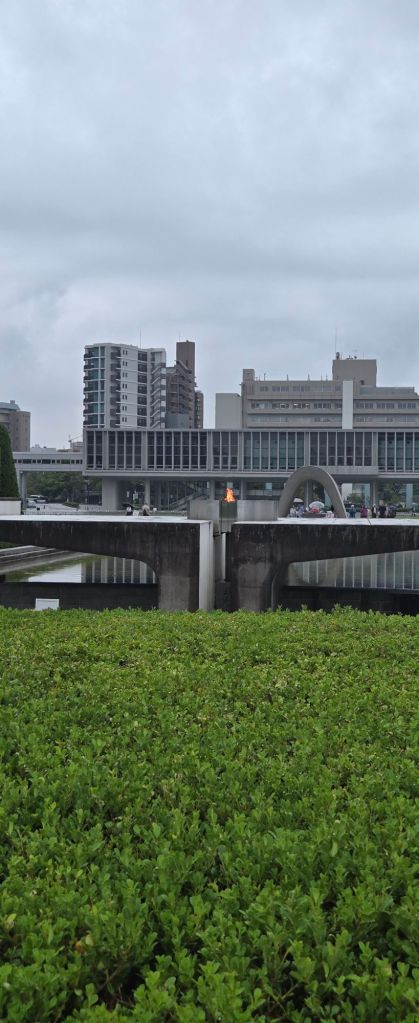
A damp grey day brought us to the scene of one of the world’s greatest atrocities, the bombing of Hiroshima on August 6th 1945. We did of course get all the relevant information and account of that fateful day, we stood on the Bridge, the original target that was missed by a couple of hundred meters, but nothing could have prepared me for the horrific, graphic, photographic account of that day.
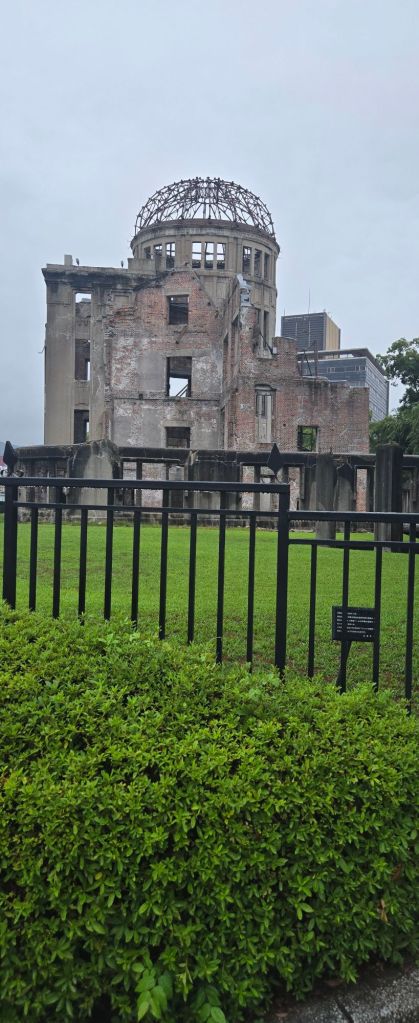
We walked to the Dome, the only building that has been preserved as a permanent reminder.
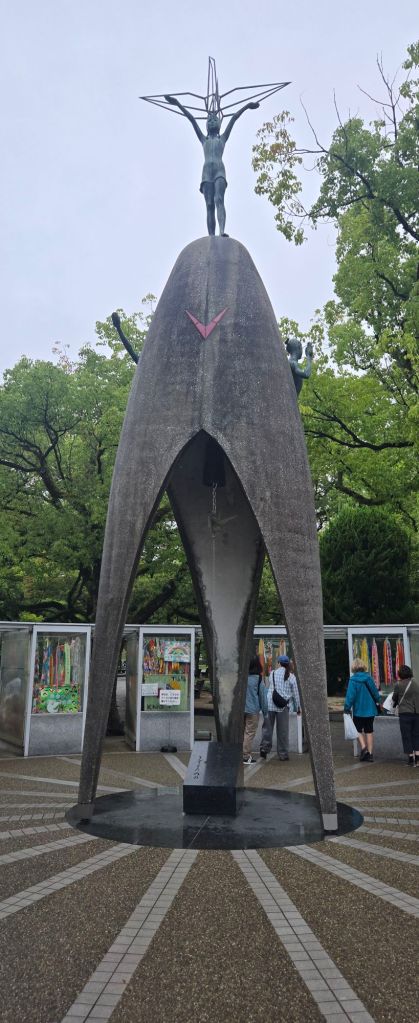
A beautiful Park has been created nearby and we stopped first at the Memorial to the Children, killed in the bombing, estimated to be almost twenty five thousand who died on the day and subsequently through illness, inspired by a little girl, Sadako Sasaki, who at 2 years old survived the blast, but succumbed to leukaemia 8 years later.
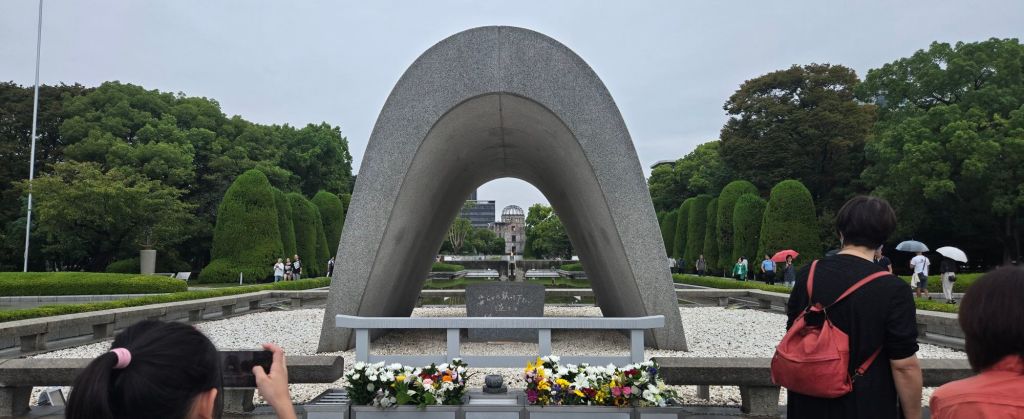
Then I walked towards the Peace Museum and stopped at the Memorial Monument to Hope and Peace. Simple, constructed artistically in granite, it has an ever lasting flame and flowers. While I stood there in contemplation, many Japanese came to bow their heads in memory. So poignant.
I then entered the actual Museum, which is modern, interactive with all the bells and whistles one finds in Museums everywhere, coffee shop, gift shop etc.
The experience is made up of four parts. Initially you get the historical data, dates, numbers etc and you then enter a somewhat darkened area as a long slow line of people walk slowly past the most horrific, graphic, black and white photographs, imaginable. All greatly magnified, they line both walls, floor to ceiling, as you walk by them, through the area. There is palpable sorrow and silence here, where the majority of people are Japanese, of all ages. Young people, babies in buggies, very elderly people, all so, so solemn. As a visitor, one almost feels like an intruder.
Many of the photography was taken by a local newspaper reporter/ photographer, who was one of the first on the scene on that fateful day. He said that initially, he was unable to photograph the horror in front of him, but then realised he had to record the horror unfolding before him. The photographs are captioned with names, where they were identified, but of course many victims were never identified. Chaotic scenes at emergency stations hurriedly set up to help the burnt and wounded are shown, as are pictures of the most horrific burnt bodies, alive, dying and dead.
In the Centre of a large room within this section, are remnants of children’s clothes, some blown of the children and some recovered from their bodies. While it is nauseating, it does serve as a reminder of the damage that nuclear arms can render.
Then there are profiles of people living for some time with the effects of radiation and some heart rending accounts told by survivors.
While photography is allowed, I could not bring myself to photogragh anything.
Then there is a Science section, elaborating on the development and use of the Atomic Bomb. This is quickly followed with detail of the Nuclear Age and Nuclear Weapons Abolition, together with detail of all the various Promises, Treaties and Government Acts of Non Proliferation, that we have heard about in the past 80 years, all to no avail, as the current world political state tests.
The Museum isn’t for everyone and I don’t apologise for writing about it here. It is part of recent history and I feel we do need to be reminded of Mans’ inhumanity to Man. I hope you agree.


That’s a heart rending account of the memorial Jean……
LikeLike